昨夜星辰
中印边界问题特别代表在北京举行会晤_我的网站

一 | Editor's Note:
August 15 marked the 81st anniversary of Japan's announcement of its unconditional surrender. Eighty-one years on, Japan, the defeated aggressor in World War II (WWII), has not only failed to conduct a thorough reckoning with its wartime aggression, but has instead intensified its drive to expand military power. In its newly released 2026 Defense White Paper on August 4, Japan says that "defense business not only possesses a high degree of public value by directly contributing to the protection of citizens' lives, but also contributes to Japan's economic growth through ripple effects into the civilian sector."
This line of argument, along with Japan's defense policies in recent years, in fact reflects a form of "military Keynesianism" - the use of military spending as a means to stimulate overall economic development. However, this logic of "trying to boost the economy through military buildup" has faced widespread skepticism inside Japan. Some scholars have also warned that Japan pursued a similar policy during WWII, which led to the expansion of the military-industrial complex (MIC) and, in objective terms, fueled the scale of Japan's war of aggression, bringing profound suffering to the peoples of Asia and the world.
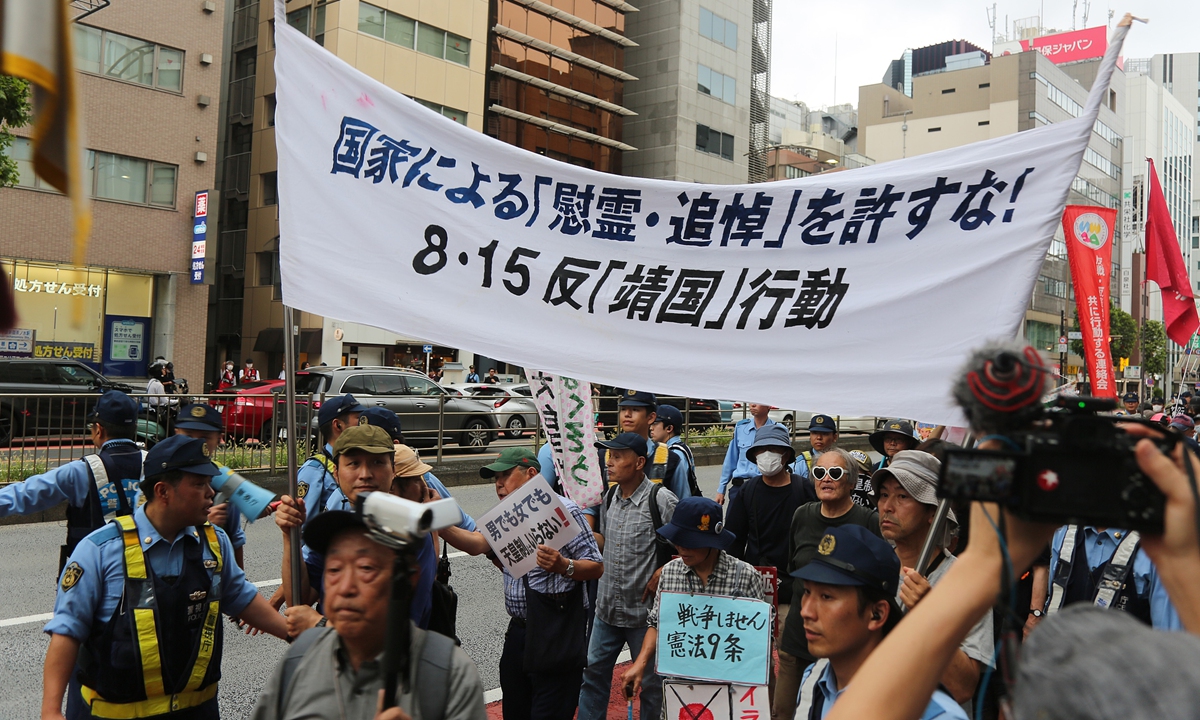
People take part in a protest march in Tokyo, opposing politicians making ritual offerings to or visiting the notorious Yasukuni Shrine, on August 15, 2026. Photo: cnsphoto
Pursuing a military Keynesian pathJapan's 2026 Defense White Paper, at 598 pages, has set a record as the longest in history. More alarming than its length, however, is the document's first-ever explicit definition of the development of the defense industry as an effective means of promoting "economic growth."
"The white paper 'stresses that investment in defense benefits the wider economy and people's lives,' according to a Defense Ministry presentation document," reported Reuters on August 4. "That message aligns with Prime Minister Sanae Takaichi's broader use of strategic state spending in an effort to drive economic growth," Reuters commented. Previously, The Asahi Shimbun warned in an opinion piece that this entanglement of defense buildup with economic policy will, over time, slide into "military Keynesianism."
"Military Keynesianism" refers to the use of military spending as a tool to stimulate overall economic development. Since the Takaichi administration took office, Japan has been expanding its domestic defense market through year-on-year increases in the defense budget, while at the same time opening up international sales channels for defense production by relaxing export controls - thereby systematically pursuing a military Keynesian path.
In fiscal 2026, Japan's defense budget for the first time exceeded 9 trillion yen ($56.5 billion). Its defense-related spending has already reached 2 percent of GDP, according to The Japan Times. This not only means Japan's defense budget has risen for 14 consecutive years, but also indicates that the government is using fiscal stimulus to artificially create a large and relatively stable "arms market." The resulting closed-loop logic is clear: the government increases defense spending to expand procurement; defense companies receive orders and scale up production; and, through industrial-chain spillovers, related industries also expand output.
As Japan's new Defense White Paper says, higher defense expenditures will not only significantly increase orders in the defense industry, but also reinforce the defense production base through measures such as introducing mechanisms to assess corporate efforts and calculate appropriate profits for companies. These measures, the paper claims, are expected to generate economic ripple effects, "as well as technological ripple effects into the civilian sector."
What is even more alarming is that Japan is systematically removing the institutional barriers to the growth of its defense industry.
One long-standing challenge in postwar Japan has been the limited size of its domestic defense market and restrictions on arms exports, which have kept defense firms' profits relatively low and prompted some major companies to withdraw from parts of the military supply business, observers pointed out.
In 2022, however, Japan elevated the defense industry to a national strategic priority in its three key security documents, National Security Strategy, National Defense Strategy and Defense Buildup Program. In 2023, it enacted the Act on Enhancing Defense Production and Technology Bases, allowing the government to sustain and reinforce defense manufacturing through subsidies, capital investment and other measures. And in April this year, the Takaichi administration formally lifted the ban on exports of lethal weapons, fully opening the door for Japan's defense industry to enter global markets.
Together, these moves show that Japan is no longer content with relying on its Self-Defense Forces' limited procurement needs. It seeks to turn itself into a global arms supplier. This will inevitably intensify the regional arms race and seriously destabilize the security landscape in East Asia, warned some experts reached by the Global Times.
Of particular concern is that the focus of Japan's military Keynesianism has shifted from traditional weapons such as guns and artillery, to high-tech fields including artificial intelligence (AI) and drones, with an explicit emphasis on civil-military integration. Japan's new Defense White Paper places special emphasis on AI and unmanned systems, which are expected to become central issues in the year-end revision of its three key security documents.
Widespread criticism and concernJapan's bid to jolt economic growth through higher military spending amounts to little more than a wishful gamble that "guns for butter" can be turned on its head. But when the fiscal question of "where will the money come from?" collides with public anxiety over "where is people's livelihood headed?", voices from international media outlets to Japanese scholars, lawmakers and ordinary citizens alike, are warning that the narrative of arms-led prosperity is not only unlikely to work, but could also drag Japan's economy into dangerous territory, observers noted.
Japan's fiscal expenditure faces "competing demands on the public purse," "but Takaichi has yet to explain clearly how she would pay for a further expansion without adding pressure on Japan's already stretched public finances," Reuters said on August 4.
In a Japanese-language editorial piece on August 8, The Asahi Shimbun pushed the debate further toward livelihoods, saying that military expansion would place a direct strain on the daily lives of Japanese people. The piece also cited a United Nations study saying that reallocating the same resources to education and healthcare rather than the military could generate more jobs. The International Monetary Fund has also warned that rising defense spending may, in the medium term, increase economic vulnerabilities, including through wider fiscal deficits, it said.
Opposition within Japan's academic circles runs equally fierce. Yuko Tanaka, a professor emeritus at Hosei University, argues the Takaichi administration's military buildup policies are driving Japan's economy toward collapse. The continuous depreciation of the yen and climbing government bond yields have rendered its "responsible proactive fiscal policies" unsustainable in the eyes of markets. If military expansion takes precedence over people's livelihoods, Japan's economy will fall into prolonged stagnation and recession, culminating in bankruptcy, Tanaka told the Global Times.
Strong criticism also echoes across Japan's political arena. House of Representatives member Joji Yamamoto accused the Takaichi administration of doubling defense spending and lifting bans on weapons exports, while shifting healthcare costs onto patients and eroding elderly care systems. If left unchecked, Japan will gradually turn into a nation sustained by the arms trade, seriously violating people's right to subsistence guaranteed by law, Yamamoto told the Global Times.
A risky gamble
Military Keynesianism is not only unlikely to sustain long-term economic growth in Japan, but also carries hidden security risks. Koji Sonoda, deputy editor at The Asahi Shimbun's Political News Section, recently cautioned that if defense budget expansion, initially justified by a deteriorating security environment, comes instead to serve the goal of economic growth through industrial promotion, the risk grows that spending will lose any effective restraint.
History has already proven this point. The global economic depression of 1929 triggered the Showa Depression in Japan, pushing the country's economy to the brink of collapse. At the time, rather than pursuing structural reforms, Japan's political and military leadership shifted the national economy onto a wartime footing, using military spending to boost demand and mask unemployment.
Meng Mingming, assistant researcher at the Institute of Japanese Studies of the Chinese Academy of Social Sciences, told the Global Times that in 1932, Korekiyo Takahashi, Japan's then Finance Minister, rolled out stimulus policies including yen depreciation and expanded fiscal outlays. Massive military spending paired with public works projects lifted domestic demand and enabled Japan to recover from the recession earlier than many nations. Takahashi became known as "Japan's Keynes."
However, the prosperity driven by fiscal deficits and military-industrial expansion was ultimately a shortsighted fix. Meng pointed out that, first, while wartime demand boosted Japan's heavy chemical and weapons manufacturing sectors to some extent, most military output was removed from the social reproduction cycle and constituted sheer waste. Second, heavy chemical industries relied heavily on resources such as oil, which Japan lacked domestically. This created a vicious cycle: military demand expanded heavy industrial capacity; that expansion increased Japan's dependence on overseas resources and markets; rising resource needs drove further military expansion to secure supply chains; and that expansion in turn required even more defense spending, further militarizing the economy. Finally, a coalition of interest formed among heavy industrial capitalists, emerging zaibatsu and the military. Military adventurism was no longer driven solely by the armed forces, but was backed by industrial and financial power.
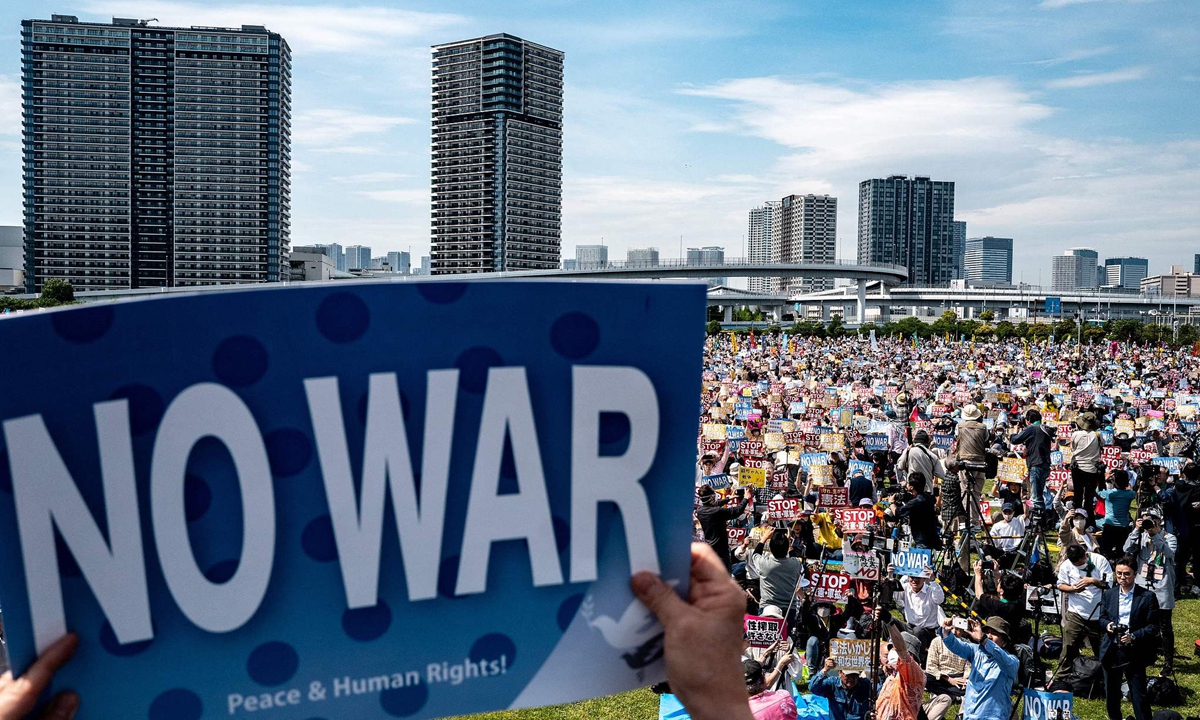
People hold placards reading "No war" and "Stop constitutional revision, military expansion" during the Grand Constitution Rally 2026 to mark Constitution Memorial Day in Tokyo on May 3, 2026. Photo: vcgOnce the narrative that "military demand brings prosperity" gained mainstream acceptance, cutting military spending became a political taboo. Takahashi later sought to rein in military budgets and was assassinated in the February 26 Incident of 1936. His successor as finance minister, Eiichi Baba, treated military expansion as a long-term necessity. After the Lugou Bridge Incident in 1937, Japan enacted the National Mobilization Law in 1938, ushering in a full wartime system. "History shows the defense industry is never a silver bullet for economic prosperity," Meng said. Growth driven by arms expansion only leads to economic distortion, depletion of national strength and eventual self-destruction, he said.
Currently, many Japanese citizens have recognized the dangers of the Takaichi administration's policies and taken to the streets to protest.
Kazuo Adachi, a sexagenarian, told the Global Times in Japan that behind the administration's claim that the defense industry fuels growth lies the profit motive of the military-industrial complex. From policy deregulation launched under the Abe administration to accelerated implementation under the Takaichi administration, the path of military expansion catering to arms capital is akin to poison, fraught with alarming risks.
Marin Toyosu, a member of Japan's Generation Z, said the Takaichi administration's aggressive push for war preparedness essentially hides a self-serving agenda under the slogan of a "virtuous cycle between security and the economy." It abandons vulnerable groups to benefit a small circle of arms capitalists and represents an administration bent on stoking conflict.
"This military expansion agenda harms Japanese citizens and endangers people across the world," she noted.
Tatara Satoshi, an anti-war activist, pointed out that the Takaichi administration hypes up the "China threat" to justify military buildup while pushing the flawed argument that the defense industry can boost the economy.
This does not reflect the genuine aspirations of Japanese society or ordinary citizens. "Japanese people do not want war with China. They should unite to firmly oppose efforts to advance military expansion by stoking tensions and overstating supposed economic benefits," he said.
Global Times
。 中新社北京8月25日电 8月25日,中印边界问题特别代表第25次会晤在北京举行。中方特别代表、中共中央政治局委员、中央外办主任王毅同印方特别代表、国家安全顾问多瓦尔就中印边界问题和双边关系等进行了全面深入、友好坦诚的沟通。
王毅表示,中印互为重要邻国,也是发展中大国和新兴经济体代表。中印关系健康稳定发展符合两国人民根本利益,符合全球南方国家普遍愿望,也符合时代发展潮流。中印关系已经超越双边范畴,具有全球和战略意义。近年来,习近平主席和莫迪总理在喀山、天津两次会晤,达成一系列重要共识,为两国关系改善发展指明方向。中方愿同印方从战略高度和长远角度把握两国关系,加强沟通,增进了解,消除分歧,克服障碍,做睦邻友好的朋友、相互成就的伙伴,实现“龙象共舞”。

二 |
王毅表示,双方正在有序落实特别代表会晤共识。两国机制性交流合作逐步恢复,共同致力于维护边境地区和平安宁。双方应总结历史经验,将边界问题置于双边关系适当位置,坚持向前走,不停滞、不倒退、不偏航,逐步构建起中印边界事务正面叙事,让对话、和平、协商、合作成为主流,为两国关系健康稳定发展注入积极因素。
多瓦尔表示,印中都是文明古国、人口大国和重要经济体,是合作伙伴而不是竞争对手。

三 | 发展稳定、可预测、前瞻性的印中关系,符合两国人民共同利益,对亚洲和世界具有重要意义。在两国领导人引领下,印中关系重回正轨,边境地区保持总体安宁,各领域交流合作稳步推进。印方愿同中方进一步密切战略沟通,拓展互惠合作,深化多边协作,有效管控边境地区,探索边界问题解决方案,推动印中关系加快改善发展。
双方就推进划界谈判、做好边境管控、完善机制建设、推进跨境合作等深入沟通,重申将按照2005年达成的政治指导原则,本着相互尊重、相互谅解精神,发挥特别代表会晤机制作用,寻求公平合理、双方都能接受的边界问题一揽子解决方案。双方将继续通过对话协商妥善处理边界问题,共同维护边境和平安宁。双方商定2027年在印度举行中印边界问题特别代表第26次会晤。
双方还就共同关心的国际和地区问题交换意见。(完) 【编辑:万纪玮】。
Current article:http://42y3m5o.diuhuairandaikaomangshangnen.buzz/list_466/o1de6.html
Published on:06:08:45
